
The mainstream e-commerce narrative across emerging markets heavily promotes Pay-On-Delivery (POD) digital transfers as a secure, seamless transaction bridge. Consumers are told that by using instant bank transfers at local fulfillment terminals, capital moves seamlessly via the Central Bank of Nigeria’s NIBSS clearing switch to authorize immediate inventory releases.
The structural reality is a broken reconciliation layer. When high-velocity platforms rely on centralized payment aggregators without real-time API ledger syncing, user capital is routinely sucked into an unassigned settlement pool. While commercial banks issue official clearance validations, the merchant’s internal order-management software leaves the user’s asset flagged as “unpaid”—triggering automated liquidation scripts that threaten to cancel the transaction while the platform retains the principal capital.
I. The Anatomy of an Aggregator Settlement Mismatch
This technical operational failure executes seamlessly across the background communication rails connecting independent fintech senders, receiving merchant gateways, and front-end marketplace databases:
[ OPay Sending Node ] ──►
[ NIBSS Central Switch ] ──►
[ PalmPay Merchant Pool ] ──►
[ Jumia Front-End Order API ]
(Disbursed Instantly)
(Session ID Generated)
(Funds Captured & Held)
(Ledger Desynced / "Unpaid")
1. Real-Time Disbursal vs. Closed Gateways
- The Blueprint: A user executes an instant NIBSS bank transfer to a merchant’s designated terminal collection account. The sending institution (e.g., OPay) processes the payload instantly, moves the liquidity down the wire, and generates an unerasable 30-digit cryptographic Session ID.
- The Siphon: The funds physically exit the sender’s account and land directly inside the merchant’s central receiving aggregator account (e.g., PalmPay) within seconds, legally closing the banking transaction loop.
2. The Internal API Sync Failure
- The Technical Mismatch: Instead of running an automated, real-time webhook that instantly pairs the incoming PalmPay credit alert with the user’s specific front-end order ID number, the marketplace database fails to reconcile the ledger.
- The Trap: Because the local terminal agent’s handheld application relies exclusively on an automated status trigger from the central database, the system leaves the physical package marked as “Pending Cash.” The money is sitting inside the corporation’s treasury pool, but the physical item remains held at the station.
3. Automated Asset Liquidation Scripts
- The Operational Damage: While low-level customer service queues pass the dispute down slow internal channels, the marketplace’s front-end system continues running its default automated routines.
- The Strategic Blow: The automated order system runs a rigid countdown clock. If the API status doesn’t manually update, the system triggers a liquidation command, scheduling the physical asset to be returned to the central warehouse while the user’s cash remains stuck inside an un-audited merchant ledger pool.
II. Case Study: The Ilorin Terminal Ledger Breakdown
This exact operational friction is currently documented on the live network tracking grids under a verified, trace-level case study:
- The Target Asset: Optimum Nutrition Gold Standard Whey Protein Powder (1.5lbs).
- The Physical Junction: Jumia Pickup Station Ilorin.
- The Core System Identifier: Package Number
1219158646. - The Verified Banking Proof: An official, signed clearance declaration from OPay Digital Services Operations confirming that Session ID
1000042605301041161244199517and Transaction ID260530020100849465482057successfully settled 81,475 Naira straight into Jumia’s PalmPay account on May 30th at exactly 11:00:35.
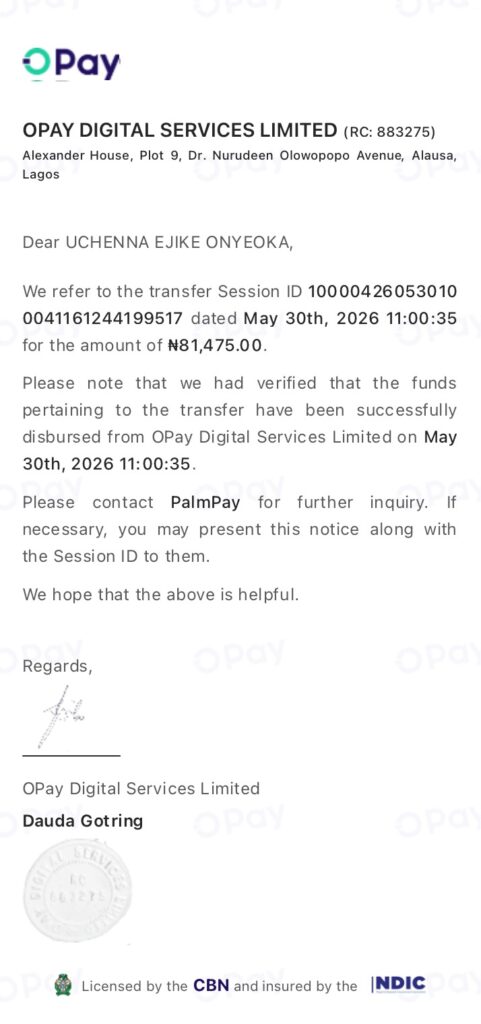
                      [ Successful OPay Disbursal (May 30th) ]
                                         │
                       (Session ID:1000042605301041161244199517)
                                         │
                                         ▼
                     [ PalmPay Receiving Infrastructure Node ]
                                         │
               ┌─────────────────────────┴─────────────────────────┐                  ▼                                                   ▼
   [ Principal Capital Captured ]    [ Jumia Order Sync Status ]
   (N81,475 Sitting in Treasury)     (Desynced 48-Hour Pending)

                                  ▼
                     [ Package 1219158646 Trapped ]

                                      ▼
                     [ Automated Cancel Threat Issued ]
Despite absolute, legal validation that the principal capital was cleared into their accounts over 48 hours ago, the front-end interface treats the transaction as nonexistent, threatening automated asset return protocols while corporate support lines stall behind standard support timelines.
III. The Sovereign Counter-Measures: Forcing Ledger Accountability
To survive aggregator synchronization mismatches, independent platforms and consumers must implement aggressive verification overrides:
- Implement Algorithmic Circuit-Breaker Holds: Multi-vendor marketplaces must re-engineer their order cancellation logic. If a user uploads a validated NIBSS banking receipt containing a unique 30-digit Session ID, the system must trigger an automatic freeze on the cancellation script, preserving the physical package location until manual auditing finishes.
- Deploy End-to-End Webhook Redundancy: Payment gateways like PalmPay must supply immediate, bi-directional API streaming data loops to their corporate clients. If a terminal transfer clears the banking switch, the status change must push straight to the local terminal handler’s screen within 500ms, completely removing human error from the loop.
- Enforce Strict Legal-Technical Escalation Paths: Technical founders must maintain real-time tracking of transaction logs. If an infrastructure provider delays reconciliation loops, developers can use automated, cryptographically signed ledger disputes to force direct settlements, ensuring cash flow stays secure.